Exodus
the eternal dance

If I try to write about Buddhism, Sufism, Taoism, Christianism, Judaism, Islamism, Trumpism, Jainism, Maoism, Sikhism, Tatcherism, Shintoism, Nihilism, Capitalism, Animism, or Humanism, I am doomed. I will never be able to grasp even a tiny part of any of it.
If I try to write about myself, I am equally doomed. I will never be able to grasp even a tiny part of that either.
The same about you. I will never be able to grasp even a tiny part of you either.
Maybe it is all the same. Maybe it is all one infinite ungraspable thing.
Anaïs Nin once wrote that we don’t see the world as it is. We see the world as we are.
Take Rastafarianism, for example.
Rastas see themselves as exiles living in Babylon, a corrupt Western world of oppression and materialism, awaiting repatriation to Zion, symbolized by Africa, and especially Ethiopia. They believe that Jah (God) resides within every individual. This divine presence is the One Soul. Therefore, all people regardless of race, nationality, or creed — are fundamentally connected as expressions of the same divine source. To recognize the God in another is to recognize the One Soul shared by all humanity.
There is a song by Bob Marley:
“One love, one heart / Let’s get together and feel all right.”
A direct call for human unity to overcome suffering. It frames oneness as the practical solution to the world’s problems.
But this song is nothing if I don’t dance it. If I don’t practice it.
Take nihilism, for example.
Nietzsche did not invent nihilism to promote it. He diagnosed it as a catastrophic cultural disease about to ravage Western civilization. And yet, in Thus Spoke Zarathustra, he wrote:
“And we should consider every day lost on which we have not danced at least once. And we should call every truth false which was not accompanied by at least one laugh.”
He is not giving wellness advice. He is not telling you to do aerobics or cha-cha-cha in your living room.
Dancing here is a profound and precise metaphor. It represents liberation from the heavy, crushing weight of traditional dogma, absolute morality, and existential despair. To dance is to achieve a lightness of spirit that defies gravity — the ability of a free spirit to move through a chaotic, seemingly meaningless world with grace and self-mastery, rather than being crushed by nihilism.
It also speaks to Amor Fati — the love of one’s fate. Nietzsche challenged humanity to accept the suffering, the pain, and the apparent meaninglessness of existence, and still find a way to joyously affirm life.
A dancer takes the raw, chaotic energy of life and shapes it into art.
To dance every day, then, is to actively embrace life’s struggles and transform them into an aesthetic, triumphant experience. Nietzsche despised rigid, absolute thinkers who became imprisoned in single, heavy dogmas. The dancer embodies intellectual agility the ability to leap between perspectives, to play with ideas, and to hold one’s own truths lightly enough that they never become tyrannical. Hence the requirement of a laugh.
The dance is the supreme, joyous defiance of an infinite universe.
There is another song we are all constantly dancing in our lives: Exodus. We are all in exile since the moment we were born.
One version of this song was made iconic by Bob Marley, who framed the Rastafari struggle through the biblical lens of the Israelites leaving Egypt. Oneness in that song is a shared destiny — a collective, unified march out of spiritual and physical bondage toward liberation.
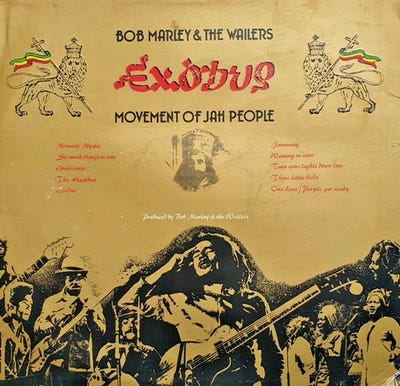
It is not merely a catchy reggae anthem for a party.
To reduce it to that is to strip it of its profound historical, political, and human weight. It is a manifesto of survival, exile, and liberation.
Then there is Tinariwen.
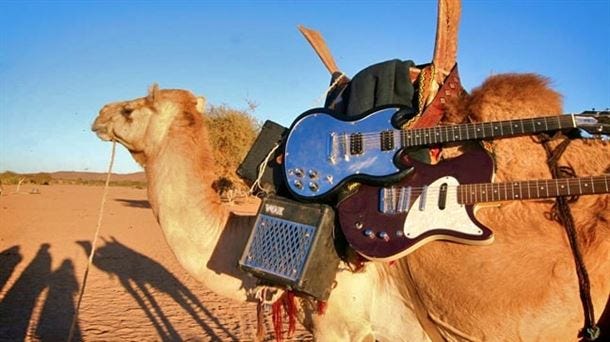
The Tuareg desert blues band from northern Mali embodies, in their very existence, the same themes of exile, struggle, and nomadic movement.
Formed in refugee camps in Libya in the 1980s, their members were Tuareg rebels who fought for the autonomy and rights of their people, a nomadic civilization marginalized and displaced by post-colonial states that ignored their cultural identity and ancestral lands.
Tinariwen participated in a collaborative track, “Tamatant Tilay / Exodus,” alongside Herbie Hancock, K’naan, and Los Lobos, as part of Hancock’s album The Imagine Project, exodus a meditation on global musical collaboration and peace.
Tamatant Tilay / Exodus (feat. Tinariwen, K'naan, & Los Lobos)
Both Bob Marley and Tinariwen channel the experience of a dispossessed people seeking liberation.
Does that sound familiar to anyone?
Marley’s Babylon finds its parallel in the governmental neglect and military conflicts that forced the Tuareg into rebellion and displacement.
The “movement of Jah people” resonates with the literal and spiritual nomadic movement of the Tuareg across the Sahara.
For Marley, Exodus was a spiritual and eventual physical repatriation to Africa, to Zion — a destination.
For Tinariwen, the movement is inherent to being human. Their Exodus is less about arriving somewhere and more about the journey itself as a form of resistance and cultural preservation. They sing of the beauty and hardship of the Sahara, the longing for ancestral lands, the resilience of traditions that survive despite political borders and armed conflict.
“Tamatant Tilay” in the Tamasheq language carries a meaning close to destiny or fate, which aligns with the inevitable, almost divine mandate at the heart of Marley’s Exodus.
The rhythmic and melodic structures of reggae, and Tuareg desert blues share a connection to ancestral African music. Both traditions use music as a vehicle for storytelling, cultural identity, and political resistance. Both rely on driving, hypnotic rhythms that embody themes of journey, endurance, and collective movement.
What differentiates this with the universal human search and struggle for freedom and belonging?
They remind us that the Exodus is not a singular event from antiquity or the present moment.
It is a perennial human condition for those living under suffering.
And what human being is not under some kind of weight, opression, blindness, conditioning, suffering…?
“One love, one heart / Let’s get together and feel all right.”
The real insight isn't only that everything is one. We humans have found ways to affirm life and create meaning despite living in systems that often forbid it. This goes beyond universal oneness.
The participants on “Tamatant Tilay / Exodus”:
Herbie Hancock (Piano, Keyboards, Producer) — The visionary behind The Imagine Project. A legendary jazz pianist, composer, and bandleader whose entire career has been about breaking boundaries between genres and cultures.
Tinariwen (Vocals, Guitars, Percussion) — Tuareg pioneers of desert blues, characterized by hypnotic guitar riffs, call-and-response vocals, and a deep, melancholic groove forged in exile and resistance.
K’naan (Vocals) — Somali-Canadian poet, rapper, and songwriter. His presence adds another urgent voice of contemporary displacement and resilience, bringing a modern, raw perspective to the themes of migration and freedom.
Los Lobos (Guitars, Vocals) — Grammy-winning rock band from East Los Angeles, known for their eclectic blend of rock, Tex-Mex, folk, R&B, blues, and traditional Mexican music. Their own story of cultural survival and identity adds yet another thread to this global tapestry.
Participants in the 1977 Exodus recording:
Bob Marley — lead vocals, rhythm guitar
Aston “Family Man” Barrett — bass
Carlton Barrett — drums
Junior Marvin — lead guitar
Al Anderson — lead guitar
Tyrone Downie — keyboards
Earl “Wya” Lindo — keyboards
Alvin “Seeco” Patterson — percussion
The I-Threes — backing vocals
Rita Marley
Judy Mowatt
Marcia Griffiths
The participants in our 2026 world:
You, me and 8,825,207,185 more.
Ooooppss…..8,825,207,186 now.
Keep dancing.
This is one of those rare pieces that manages to hold so much at once: exile, belonging, music, and the stubborn hope that we can still dance even when the world feels heavy. The way you connect Marley and Tinariwen, and show how the movement itself becomes meaning, really lands. Maybe that's all any of us can do: notice the struggle, honor it, and keep moving, together or alone. Thanks for the reminder that the journey is worth making, even if we never quite arrive.
I was already with you at the whole ungraspable thing of religion, self, other, and then the Marley to Tinariwen thread made my brain light up in the nicest way.